
How to Lay Paving Slabs on Soil
- Creations Building & Landscaping

- Apr 9
- 4 min read
If the question is whether paving slabs can be laid directly on soil, the honest answer is yes, they can be placed there. But if the question is whether that is a good way to build a patio that stays level, drains properly, and lasts, our answer is usually no. At Creations Building & Landscaping, we build patios and paved spaces to be long-lasting, and that is why our own process starts with groundwork, drainage where needed, and a strong compacted base before the paving surface is laid.
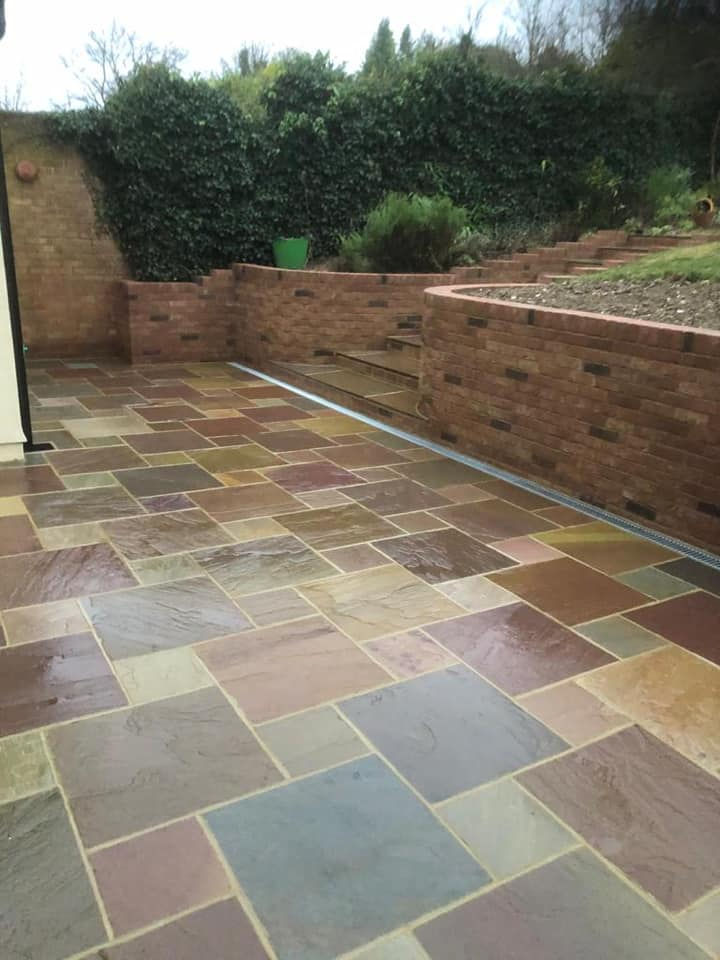
Is it possible to lay paving slabs on bare soil?
In the loosest sense, yes. A homeowner can place slabs on soil and create a rough hardstanding area, or set a few slabs into the ground as stepping stones. But that is very different from installing a proper patio. Soil shifts with weather, moisture and foot traffic, and topsoil in particular is a poor base because it contains organic matter that breaks down over time and causes settlement. Pavingexpert puts this very plainly: it is bad practice to lay paving over topsoil, and all topsoil should be removed to reach a firm, stable sub-soil before a proper paved build-up is installed.
Why laying slabs straight onto soil is usually a bad idea
The main problem is movement. Soil is not a consistent structural base, especially in gardens where it may be soft, recently disturbed, rich in organic matter, or prone to becoming wet and loose in winter and dry and shrunken in summer. That makes it much more likely that slabs will rock, sink, spread apart, or develop uneven trip points over time. A proper patio is designed to avoid exactly those problems by using excavation, a compacted sub-base and a full bedding layer rather than relying on the soil alone.
Another issue is drainage. A patio should shed water in a controlled way rather than trapping it underneath slabs or allowing it to pool against the house. Creations Building & Landscaping specifically includes drainage in the process where required and installs a strong compacted stone base to support the paving and keep everything level. Without that preparation, a slab-on-soil patio is much more vulnerable to puddling, frost movement and washout beneath the paving.
When might slabs on soil be acceptable?
There are a few limited cases where placing slabs on soil can make sense. One is a simple stepping-stone path through a lawn or border, where the slabs are not expected to perform like a formal patio. Another is a very temporary surface where appearance and long-term durability do not matter much. In those situations, homeowners are not really “installing a patio” in the proper sense. They are simply placing paving units in the garden for light use.
For anything intended as a seating area, dining patio, entertaining space, or route used every day, we would not class direct-to-soil laying as a good long-term solution. At that point, it is worth doing the groundwork properly so the finished result looks better and lasts longer.
What should be under paving slabs instead?
For a proper patio, the paving should sit on a prepared construction build-up rather than on bare soil. On our paving page, we describe the process clearly: the area is cleared and dug to the correct depth, drainage is added if needed, a strong base layer of compacted stone is installed, and then the chosen paving surface is laid with care. That is exactly the difference between a patio that stays solid and one that starts moving after the first wet season.
Manufacturer guidance follows the same logic. Bradstone’s patio installation guidance says paving should be laid after excavation that allows for sub-base, mortar bed and paving thickness, while Marshalls’ installation guidance states that paving should be rigidly installed and supported on a mortar bedding of suitable thickness. For porcelain in particular, Marshalls says it should be installed on a full mortar bed, never on spot bedding or makeshift support points.
Does the type of soil matter?
Yes, very much. Some gardens have firmer sub-soils than others, while some hold water badly or move more with seasonal change. Heavy clay, damp ground and recently disturbed areas are especially poor candidates for simply dropping slabs onto soil and hoping for the best. Even where the ground feels firm, that does not remove the need for a proper base if the goal is a finished patio rather than a temporary fix.
What about patios close to the house?
This is where good preparation matters even more. If paving is too high or badly drained near the property, it can create moisture and runoff problems. Bradstone’s homeowner guidance notes that paving should be set at least 150mm below the damp-proof course to help protect the property from damp. That is one more reason we would always recommend treating a new patio as a proper construction job rather than just laying slabs onto the soil surface.
Our view
At Creations Building & Landscaping, we would say this: laying paving slabs directly on soil is possible, but it is rarely the right way to build a patio. It may work for temporary slabs or informal stepping stones, but it is not the standard we would recommend for a garden seating area or properly finished patio. Our own paving service is built around preparation, sub-base installation, drainage where needed, and careful laying because that is what gives homeowners a patio that feels solid, looks smart and stands the test of time.
Final thoughts
For homeowners wondering how they can get a patio on soil in their garden, the simplest answer is that the soil is only the starting point, not the finished base. A good patio is built over prepared ground, not straight onto topsoil. So while it is technically possible to put slabs directly on soil, it is usually a shortcut that leads to movement, unevenness and disappointing results. A proper patio needs the right depth, the right base and the right installation method underneath it.


Comments