
How to Build Steps with Bricks and Slabs
- Creations Building & Landscaping

- Apr 16
- 5 min read
Updated: Jul 22
At Creations Building & Landscaping, we usually explain this job in five parts: set out the levels properly, dig and pour a solid footing, build the brick risers or side walls, install a compacted sub-base behind and beneath the steps, then lay the slabs accurately so the finished steps are level, durable and safe to use. That overall approach fits the way we already build paving and brickwork projects across Reigate and Surrey, where groundwork, drainage, base preparation and neat finishing are treated as the foundation of a long-lasting result.
Start with the rise, the going and the layout
The first job is always measuring the total height you need to climb and working out how many steps that height should be split into. The important part is consistency: each rise and each tread should match throughout the flight, because irregular steps are where gardens start to feel awkward and unsafe. Government guidance distinguishes between different situations, but it consistently expects step dimensions to be uniform. Where external stepped access forms the approach to a private entrance, Approved Document M says steps should be uniform, with a rise of 75–150mm and a minimum going of 280mm. Approved Document K also gives dimensional guidance for private stairs and is the main safety document covering stairs and steps more broadly.
In practical garden terms, we always advise setting the finished levels first rather than trying to “make it work” as you go. That means deciding where the top landing will finish, where the bottom step will meet the path or patio, and how the steps will sit within the wider garden. This is especially important if the steps connect to a new patio, path or raised area, which is why our landscaping and paving work is planned as one joined-up build rather than as separate bits of work.
Build the foundations before thinking about the finish
Good-looking steps can still fail if the base underneath is poor. The ground needs to be excavated to a suitable depth, taken down to something firm, and then supported with the right footing and sub-base build-up for the size and weight of the steps. On our own site, we make the same point in our paving process: we clear the area, dig to the correct depth, install drainage where needed, and then put in a strong compacted stone base before laying the finished surface.
That same principle matters even more when brickwork is involved. Our brickwork page states that we handle proper footings and drainage where needed, and that is exactly what outdoor steps require if they are going to stay straight and stable over time. If the steps are retaining soil at the sides, or tied into a raised garden level, that structural side of the build becomes even more important.
Use bricks for the risers and structure
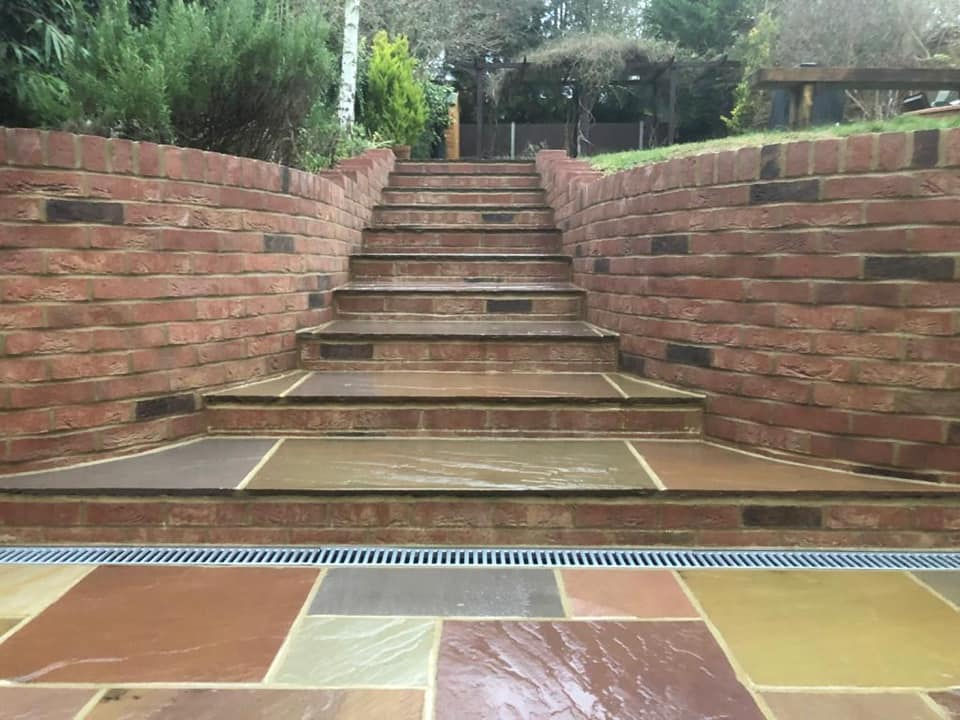
When people ask how to build steps with bricks and slabs, the usual arrangement is bricks forming the risers, side walls or retaining edges, with slabs used as the treads and landings. That method works well because it combines the strength and clean detailing of brickwork with the wider, more finished look of paving slabs on top. It is also very much in keeping with the kind of work we already carry out, as our site specifically lists brick steps, retaining walls and bespoke garden brickwork features as part of our brickwork service.
At this stage, accuracy matters more than speed. The brick courses need to be set out so the finished slab treads all land at the correct height, and the side walls or risers need to stay true from bottom to top. This is one reason brick-and-slab steps usually look best when they are designed as part of a wider patio, path or entrance scheme rather than added as an afterthought.
Install a solid base behind and beneath the slabs
Once the brick structure is in place, the area behind and beneath the treads needs to be filled and compacted properly. A strong sub-base helps support the slabs, keeps the steps level and reduces the risk of movement later on. Our paving installation process describes this clearly: the compacted stone base is what supports the paving slabs or blocks and keeps everything level.
This is also where water management needs to be considered. NHBC guidance for external works says surfaces should have proper line and level and appropriate falls, and our own paving page notes that drainage may be needed to stop pooling and protect the property. In other words, steps should not just look square and neat; they should also shed water sensibly.
Lay the slabs carefully and finish the edges neatly
The slabs form the visible top of the steps, so this is where the quality of the finish really shows. We prefer this stage to look deliberate rather than improvised: straight cuts, even joints, consistent overhangs where appropriate, and slabs chosen to match the surrounding patio or path. Our paving service includes block paving, porcelain paving and natural stone paving, so the best slab choice really depends on the style of the garden and how the steps need to tie into the rest of the scheme.
If the steps sit near a driveway, entrance or front garden, it can also make sense to coordinate them with nearby finishes so the whole property feels joined up. That is one reason our driveways, paving and brickwork services often overlap on the same project.
Keep safety and regulations in mind
Outdoor steps are not just a decorative feature. If they form part of the main approach to the house, sit beside level changes, or involve retaining work, the dimensions and safety details matter. Government guidance in Approved Document K covers protection from falling and the design of stairs and steps, while Approved Document M gives additional guidance where stepped access forms part of an entrance approach. The safest route is always to build steps that are uniform, well-drained and proportioned for comfortable use, and to get professional advice where the design is more complex.
Our view
At Creations Building & Landscaping, we think the best brick-and-slab steps are the ones that look simple when they are finished, because all the hard work has gone into the setting out, foundations, drainage and brickwork underneath. That is why we approach them as part of the whole garden rather than as a small isolated feature. With over 20 years of experience shown across our site, we build patios and paving, brick steps and walls, and wider landscaping projects across Reigate and Surrey, with free consultations available


Comments